Friday, January 16, 2015

20 Interior Design Trends for Prospective Home Buyers-- 10 They Want and 10 They Don't Want

We at City Liquidators get a lot of people coming in who flip houses and/or are furnishing new places. Ever curious about what prospective buyers look for and stay away from? Look no further, we're here to help!

10 Wants
Courtesy of http://www.newhomesource.com/resourcecenter/articles/top-10-features-home-buyers-want
Classic is better and space and light make a home feel warm, welcoming, and airy. You want to instill a sense of calm and security to anyone who enters so they can picture themselves and their loved ones in the new space and, in turn, buy it at the end of the day.

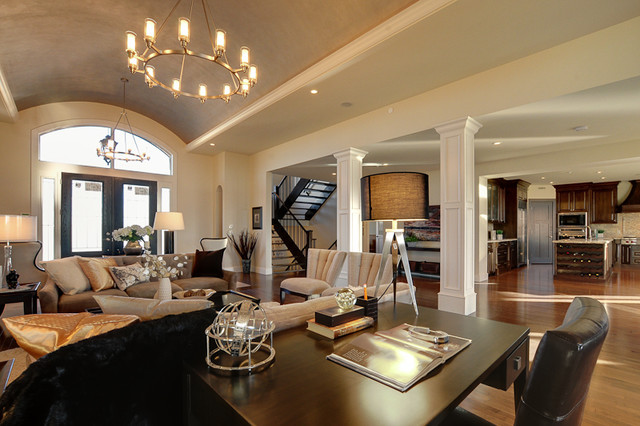
1. Open Concept Homes
    • Spacious, open living spaces feel more freeing. These are also more important for families with small kids so the parents are able to keep an eye on the kids at all times.
 
2. Smaller Homes
    •  Huge places are expensive to maintain, heat, and cool. Plus, the bigger the place, the more we want to fill it. So many people choose smaller places for less clutter, more coziness, and less living expenses.

3. Outdoor Living Spaces
    •  Many people have pets that need space to run around outside. Families also love spending time with each other outside. "For example, the 2011 Design Driver Survey from AvidBuilder found that 31.4 percent of move-up buyers (people moving to a larger home) said they either must have or really want an outdoor fireplace" (McKenzie).

4. Neutral Decor
    •  You can still keep your true accents, just try and stay more on the timeless and neutral for most of the home. The safer, the better when it comes to home buyers.

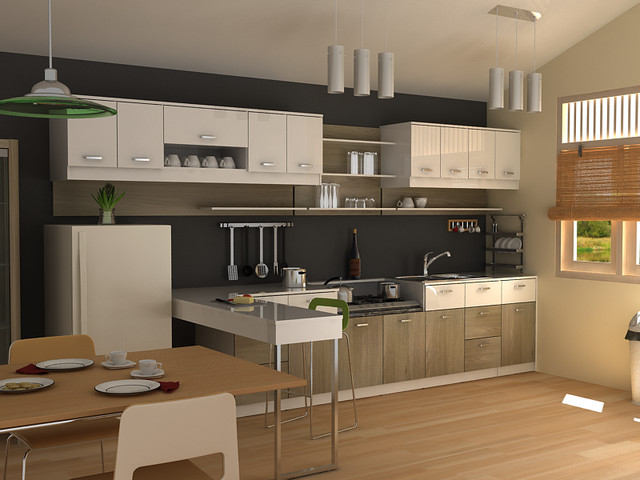
5. Modern Kitchens
    •  The kitchen is the heart of your home, so be sure to keep everything up-to-date for the safety and convenience of the future homeowners and their families.

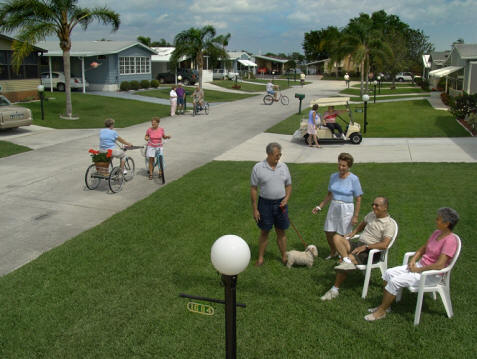
6. Smart Growth
    •  If your place is in a master-planned home community, make sure that future buyers know about all of the benefits of it. These are things that include "community clubhouses and pools, protected nature areas, hiking trails, playgrounds, and more" (McKenzie).

7. Going Green.
  •  Save the environment! "Hands down, new homes win here, too. The Home Energy Rating System (also known as a HERS Score) is an industry standard that rates the energy efficiency of homes. The lower the score, the more energy efficient the home. As the people behind HERS point out on their site (http://.www.resnet.us/hers-index) the U.S. Department of Energy has determined that a typical new home is 30 percent more energy efficient than a typical resale house" (McKenzie). 

8. Linen Closets and Smart Storage Options.
    •  Walk-in closets over small, cramped holes in the wall will take first place any day.


9. Energy-Efficient Fixtures and Appliances.
    •  According to newhomesource.com, "today's new homes feature enormous energy efficiency in appliances, HVAC (heating, ventilation and cooling equipment) and throughout the house." Now is the time to conserve the environment and change it for the better. Most home buyers will go for that versus making the environment worse and driving living expenses up as a side effect.

10. Double-Car Garage with Organized Work/Storage Space.
    •  Many sellers and builders nowadays offer three-car garages or up, but the lowest you should go is two. Most families now have at least two cars or more, and if they don't use the garage for their cars, they usually use it as a work space and organization is key for productivity.


10 Things They Don't Want
Courtesy of http://www.realtor.com/advice/10-interior-design-trends-turn-off-home-buyers/
Always remember that even though it may be trendy or appealing to have your place pop with bold colors, patterns, etc., with buyers you need to be as neutral as possible. You want to appeal to the masses so you can get your home sold as quick as possible, so remember, classic and timeless is better. Avoid the following below to make your place more palpable.

1. Boldly-Painted Walls.
    • Instead of having the walls boldly-painted, keep them neutral and provide your pops of color with accessories like pillows or throw blankets. This makes it easier for prospective buyers to relax and visualize themselves in your space. 

2. Wallpaper.
    •  The same rule goes for wallpaper as the bold walls. Put your patterns in your accessories as opposed to your walls, so prospective buyers aren't put off.

3. Lavish Light Fixtures.
    • Fixtures should be accents and not steal the spotlight. If they're too flashy, they might turn off your buyer.

4. Gleaming Gold.
    •  Gold can transport buyers back to the 80s, and sometimes not in a good way. If you do include gold, make sure it seems more industrial to stay on the safe and more modern side.

5. Converted Garages.
    •  If your converted garage is some kind of a niche space, like a music studio, it is very rare that it will fit your potential buyers.

6. Converted Bedrooms.
    • This is the same as with converted garages. Make sure you can easily convert it back to its original purpose if the bedroom is converted to something else.
7. Carpets.
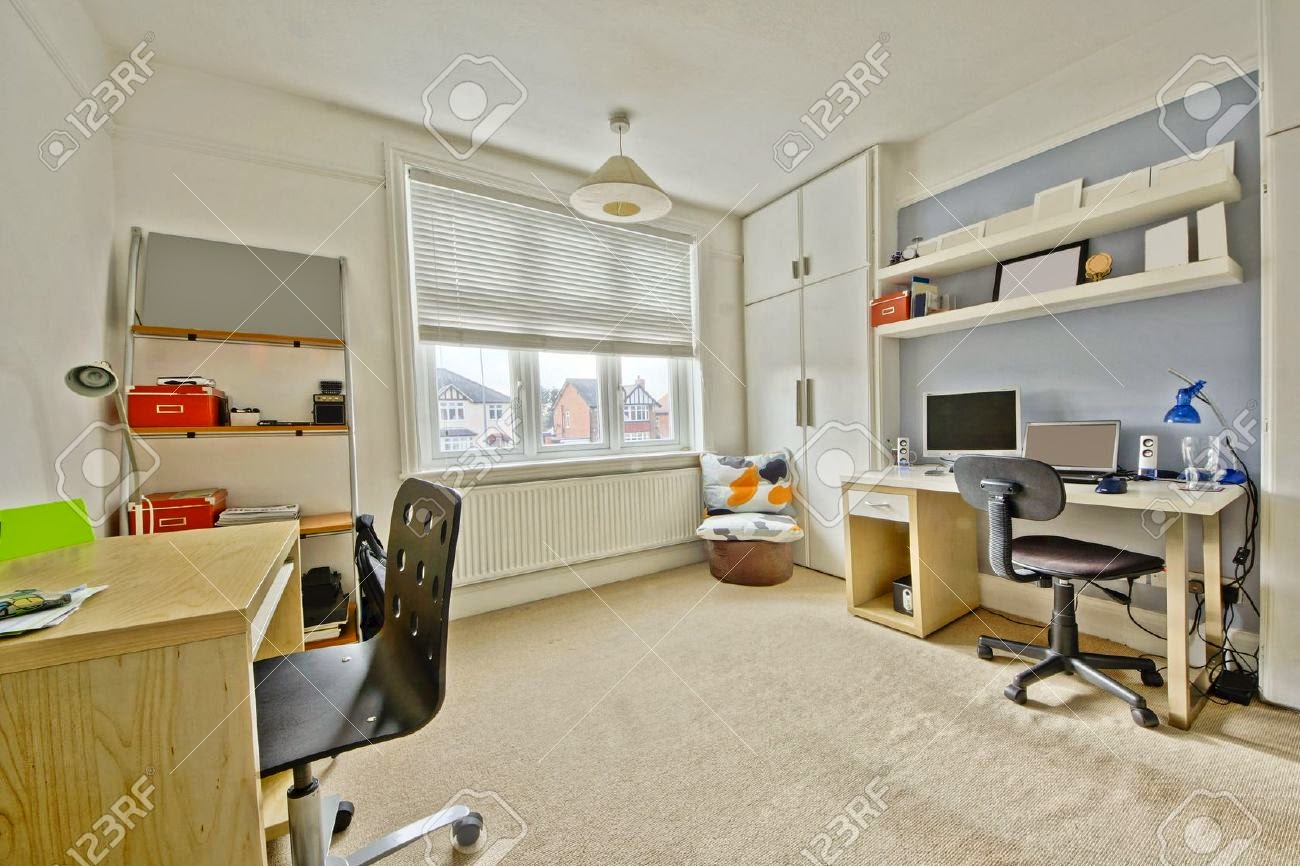
    •  Most home buyers prefer hardwood floors. Carpets trap dirt, germs, and smells. If you do have carpeting, make sure it is classic, timeless, and clean.


8. Too-Lush Landscaping.
    •  Overly landscaped places require a lot of time, money, and maintenance. The easier, the better for your buyers.

9. Pools and Hot Tubs.
    •  Pools and hot tubs are difficult and expensive to maintain. They are also HUGE health and safety hazards to families with small children. If it is in a home community, it's not as big of a deal. But if the pool and/or hot tub are in the home's backyard, it will be more difficult to sell.

10. Pet Products.
    •  Pet items, even for pet-owners, symbolize dirt and germs. No matter how fancy your pet products are, clear your place of them to make your home easier to buy.

As always, we have plenty of home decor and furniture to outfit your place, selling or not. For a glimpse, visit our site or Pinterest. We are constantly updating, but don't have nearly all of our products up. Visit us any day 9am-6pm and we'd be more than happy to help. Have a great weekend (we also have doughnuts and coffee on the weekends for free)!

Wednesday, January 14, 2015

Have a Healthy Quick-Start Breakfast Smoothie Recipe on Us!

We at City Liquidators are committed to helping you stay healthy... and our products are the perfect things to assist with that. They are part of a complete awesome, space-worthy experience.

Fun Glasses for Sale

(Star Trek Collectible Glasses for sale at City Liquidators for only $1.99!)

(Star Trek Collectible Glasses for sale at City Liquidators for only $1.99!)


Quick Start Breakfast Drink Recipe
Courtesy of AllRecipes.com


Ingredients:
Original Recipe makes 4 Servings.
Prep Time: 10 Minutes.
Ready in: 10 Minutes.
  • 2 Cups Pineapple Juice.
  • 2 Bananas.
  • 2 Cups Vanilla Yogurt.
  • 1 Cup Strawberries, Hulled (hulled: the leafy stem needs to be removed) 
  • 1/4 Cup Wheat Germ.
  • 1 Teaspoon Vanilla Extract.
  Directions:
  • Combine all ingredients in a blender and blend until smooth.
  • Distribute in awesome City Liquidators glasses and enjoy!
We'd love to hear about your experience with our products and recipes! Comments are welcome. Have a stellar day!


Monday, January 12, 2015

See our Horse and Buggy! A Post on the History, Anatomy, and Types

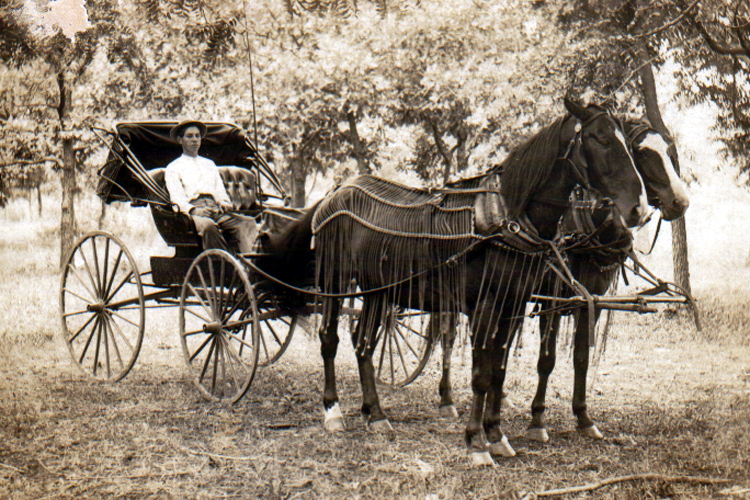
Here at City Liquidators, we're really into antiques and their history. In one of our various rooms, on the third floor of our main warehouse store, is a buggy from the early 1900s. Curious? The image is down below.
For just $2999, this baby can be yours. Feeling a little unsure about the price? Let us soothe you with the fact that it's at 1993 prices! That's because we care. Well that, and our owner, Pam Pelett, bought this beauty in Europe back in 1993. Below is the sign in the antiques room, straight from her heart to you.


A Brief History 
Buggies were an important mode of short-distance transportation back in the day. This was especially important between the years of 1815 and 1915. During that era, horseback riding in rural areas was less common and required more skill than driving. Horsemanship skills were more for the aristocratic American and British landowners. Until the mass-production of the automobile and the reasonable prices that the working-class could afford, horse and buggy was the most common and reliable means of transportation.

Anatomy of a Carriage

 (Photo courtesy of http://199.253.17.48/CarriageID.html)

Types of Carriages--Single Seat

Buckboard
  • Developed in the first third of the 19th century.
  • A four-wheeled vehicle with a floor made of springy wood like Ash, with several planks, about one inch thick, attached to the axles. The springiness of the wood was supposed to substitute for steel springs and provided comfort over rough roads.
  • Seat near the center on risers.

Buggy
  • Extremely popular, economic, and versatile.
  • Variety of styles.
  • Hung on a side bar or end springs.
  • Also produced with a cut under option (a sculpted underbelly).
  • Buggies without tops also known as Road Wagons or Runabouts.


Coal Box Buggy
  • Body cut down in the front and back.
  • Name comes from its resemblance to a grocer's coal box.
 
(A Coal Box Buggy. Photo courtesy of http://199.253.17.48/SingleSeat.html)

Concord Buggy (or Wagon)
  •  Shallow body, straight or slightly curved.
  • Mounted on a Concord body consisting of three reaches and steel side springs.


Goddard Buggy
  •  Popular drop-front body designed by Thomas Goddard.


Square-Box Buggy
  • Most common type of buggy.
  • Name is synonymous with the Piano-Box Buggy except the Piano-Box Buggy has rounded corners.
(An end-spring square-box buggy. Photo courtesy of http://199.253.17.48/SingleSeat.html)

(A Sidebar Square-Box Buggy. Photo courtesy of http://199.253.17.48/SingleSeat.html)
(A Piano-Box Buggy. Photo courtesy of http://199.253.17.48/SingleSeat.html)


Skeleton Wagon
  • Very light-weight, four-wheeled trotting wagon.
  • Intended for use on the track.

Queen's Body Phaeton
  • Lady's pleasure vehicle.
  • Characterized by its graceful curved bottom line.
  • Shown here with a basket body.

Types of Carriages--Multiple Seat

Bronson Wagon
  • Several versions made by different companies, ie: Lenox; Beach and Country Club Wagons.
  • Brewster and Co. was the original manufacturer.
  • Light, three-spring driving wagon.
  • Normally has two seats.
  • Finished with natural wood.

Break, Roofseat
  • Adapted from the heavier vehicles used to train horses to harness.
  • An owner-driven outing and sporting vehicle.
  • Seat height made it popular at spectator events.
(A Roofseat Break. Photo courtesy of http://199.253.17.48/MultiSeat.html)

Break, Skeleton
  • Important in large stables.
  • Used for training young or unruly horses, and for exercising teams.
(A Skeleton Break. Photo courtesy of http://199.253.17.48/MultiSeat.html)

Coach, Private Road
  •  For the sport of four-in-hand driving, which was a popular pastime in the northeast in the 18th and 19th Centuries. 
  • The New York Coaching Club used reproductions of early English Mail Coaches for private coaching trips with family and friends. A series was also run in famous cities and resorts for pleasure.
(A Private Road Coach. Photo courtesy of http://199.253.17.48/MultiSeat.html)


Dog Cart Phaeton
  • Same usage and characteristics as a two-wheeled dog cart.
  • Usually constructed with a cut-under body when set on four wheels.
(A Two-Wheeled Dog Cart. This is usually used for tandem driving. Photo courtesy of http://199.253.17.48/images/ID%20Images/DogCart2.jpg)
 
 (A Four-Wheeled Dog Cart Phaeton. Photo courtesy of http://199.253.17.48/MultiSeat.html)

Driving Phaeton with Spindle Seats
  • Phaeton class is probably the most diverse type of horse-drawn vehicle.
  • Has no driver's seat. Is owner-driven.
  • Popular as a sporting and pleasure vehicle.
  • This one's doors are designed to give easy entry to the back seat.

Ladies Phaeton
  •  Small and light vehicle.
  • Generally low to the ground for easy access.
  • Characterized by graceful curving lines.
  • Often equipped with a rumble seat (seating for servants in the back of the carriage, not where the owners are) for the accompanying groom (horse groom, not wedding groom).
  • If no rumble, the groom would ride along on horseback.


Rockaway
  • Four-wheeled covered carriage with panels, curtains, or glass sides.
  • Drivers' seats included in the body proper and on the same level as the rest of the seats.
  • Common roof covers all of the seats.
  •  Depot Wagon (or Station Wagon) is a form of the Rockaway.
(A Rockaway. Photo courtesy of http://199.253.17.48/MultiSeat.html)

(A Depot Wagon. Photo courtesy of http://199.253.17.48/MultiSeat.html)


Spider Phaeton
  • Gentleman's Phaeton with a Tilbury body (the two-wheeled version of a Spider is a Tilbury Gig) set on four wheels with a skeleton grumble for the groom (horse groom, not wedding groom).
  • Very popular for pleasure and competitive show.
(A Tilbury Gig c. 1830. Photo courtesy of http://www.scienceandsociety.co.uk/results.asp?image=10326088)


Stanhope Phaeton
  • Square-box body with a curved front seat and rail back seat for one or two grooms (horse grooms).
  • Often equipped with a falling top for the front seat only.
  • Suspension usually on elliptic springs, but also found with platform or mail springs.
  • Name derived from the Stanhope pillar that extends from the front seat at the front end down to the molding of the body.
  • Similar to the Mail Phaeton, although lighter in construction.
  • Utilizes mail (or telescoping) springs.


Trap
  • Principle feature is the sliding, swinging, or pivoting seats, which allow the accommodation of two to four people. 
  • Rear seat can be made to face forward or backward.
  • Short wheel base accentuates the overall appearance of height.
  • No tops provided with this vehicle.
(A Three-Spring Trap. Photo courtesy of http://199.253.17.48/MultiSeat.html)

Wagonette
  • Can be found large or small, open or closed.
  • Principle feature is the longitudinal seats behind the driver's seats, facing one another.
  • Access gained by a rear door.


Types of Carriages--Coachman Driven

Barouche (also known as a Caleche)
  • Member of the Coach family. 
  • Consists of the undercarriage and lower quarters of a coach, including the lower halves of the doors.
  • Passengers sit facing one another, usually with a folding forward seat, and the driver's seat is elevated.
  • Has a falling top to cover the back seat, but is only occasionally equipped with an extension top that covers both passenger seats.


Brett
  • Modified, lighter version of the Barouche.
  • Also known as an American Barouche.
(Small doors are open in this photo. Courtesy of http://199.253.17.48/Coachman.html)

Brougham
  • Originally developed in 1838 by Lord Brougham.
  • Original use intended as a gentleman's carriage.
  • Full-paneled coupe body, compact, and low-hung, with a paneled boot for the driver.
  • Made for two passengers, although a third could ride in the front with the driver.


Clarence
  •  Similar to Brougham, but not the same.
  • Has a semi-circular or bow-front glass and two seats inside for up to four passengers.


Coach
  • Enclosed carriage for the conveyance of passengers with the driver's boot framed into the body.
  • Widely-varied family, from European royalty to American workman's coaches.
  • Large, usually closed, four-wheeled carriage with two or more horses harnessed as a team, controlled by a coachman and one or two postilions.
(The Gold State Coach of the British Monarch. Photo courtesy of http://en.wikipedia.org/wiki/Coach_%28carriage%29#mediaviewer/File:Gold_state_coach.jpg)


American Town Coach
  • This American Town Coach is a Curtain Coach, named because of the curtains on the vehicle.
  • Other types:
    • Glass Coach: has glass windows.
    • Closed Coach: has solid panels.
    • Combo.
  • Privately-owned.
  • Finely furnished and popular with the well-to-do in the post-revolutionary era until the 1850s.


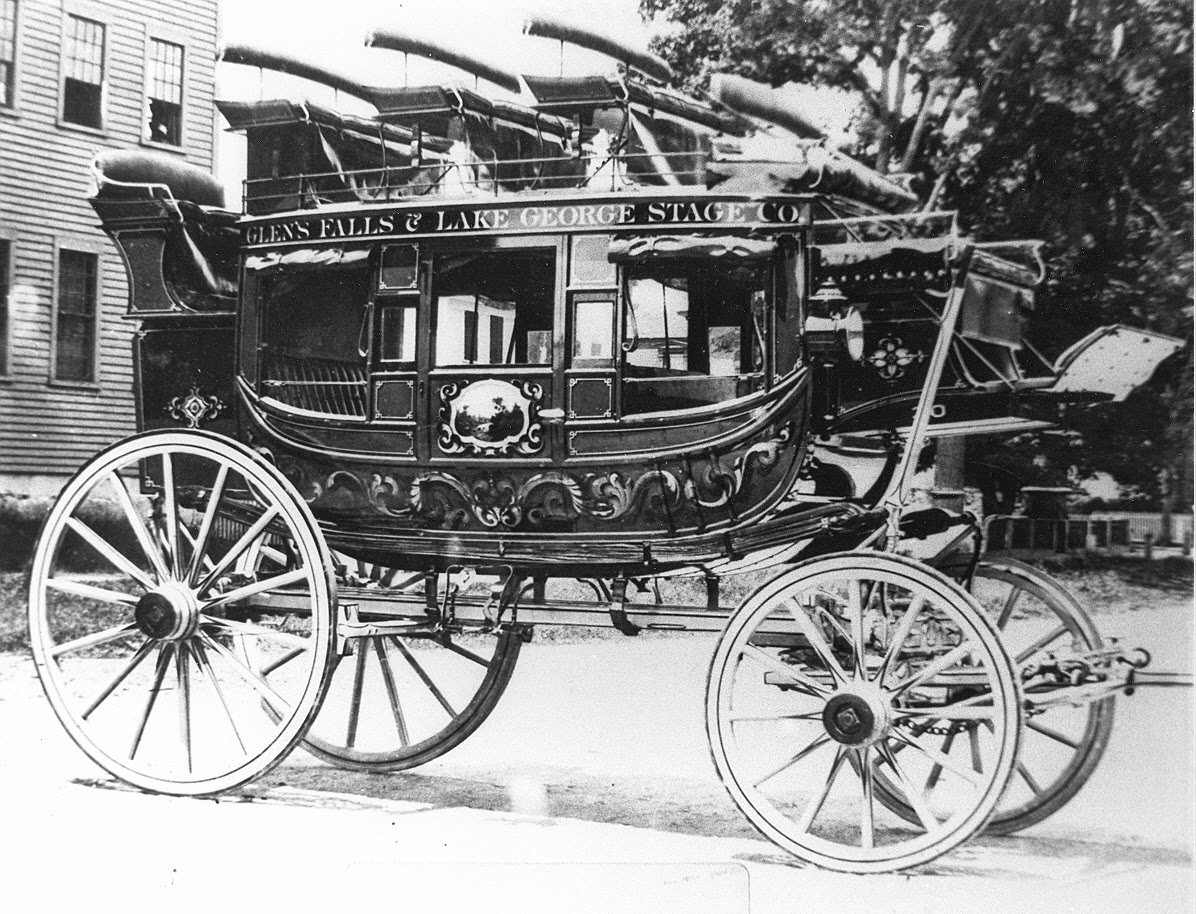
Heavy Concord Coach
  • Originally manufactured by the Abbott-Downing Co. of Concord NH.
  • Used as stagecoaches and hotel coaches.
  • Built in various sizes.
  • Largest accommodated up to 12 inside passengers and a large amount of luggage.
(A Heavy Concord Coach. Photo courtesy of http://199.253.17.48/Coachman.html)


(A Concord Hotel Coach. Photo courtesy of http://199.253.17.48/Coachman.html)


Hansom Cab
  • Mainly used as a public vehicle, but had limited private use on occasion.
  • Most common in London. Gained acceptance in the U.S. in the late 19th Century, mainly in NYC.


Landau
  • Essentially a coach with a falling top.
  • Top is two separate pieces that lock together when up.

 (Photo courtesy of http://199.253.17.48/Coachman.html)

Opera Bus
  • Related to the Omnibus.
  • Public vehicle.
  • Sometimes called a Private Omnibus.
  • A short passenger compartment behind the elevated driver's seat with glass.
  • Seats run lengthwise facing one another, wagonette-style.
 (Photo courtesy of http://199.253.17.48/Coachman.html)

Victoria
  •  Mainly used as a park carriage.
  • Name was applied by the French in honor of Queen Victoria.
  • Panel-Boot Victorias have the driver's seat framed in the body. Sometimes called a Cabriolet.
  • Many Victorias have a child's seat that folds down from the rear of the panel-boot.
  • Methods of suspension vary.
  • Found with four elliptic springs, elliptic and platform springs, c-springs, or double suspension.
(An Eight-Spring Victoria.  Photo courtesy of http://199.253.17.48/Coachman.html)


Vis-à-Vis (also known as a Sociable)
  •  French for "face-to-face."
  • Name is derived from the passenger seating arrangement.
    • Originally built for two passengers, the body was later widened and some could carry six passengers.
    • Term was later used for passengers sitting facing one another.
(A Basket Body Vis-à-Vis. Photo courtesy of http://199.253.17.48/Coachman.html)

Yellowstone (or Sightseeing) Wagon
  • Passenger wagon on a thoroughbrace.
  • Used as an excursion or sightseeing wagon.
  • Built with an open body, three or four seats, and a canopy top.
  • Originated with Abbott-Downing Co. of Concord, NH.


Wanna give a guess at what kind of carriage ours is? Feel free! Comments are welcome below. Swing on by today to say hello and see this important piece of history.