Monday, January 12, 2015

See our Horse and Buggy! A Post on the History, Anatomy, and Types

Here at City Liquidators, we're really into antiques and their history. In one of our various rooms, on the third floor of our main warehouse store, is a buggy from the early 1900s. Curious? The image is down below.
For just $2999, this baby can be yours. Feeling a little unsure about the price? Let us soothe you with the fact that it's at 1993 prices! That's because we care. Well that, and our owner, Pam Pelett, bought this beauty in Europe back in 1993. Below is the sign in the antiques room, straight from her heart to you.


A Brief History 
Buggies were an important mode of short-distance transportation back in the day. This was especially important between the years of 1815 and 1915. During that era, horseback riding in rural areas was less common and required more skill than driving. Horsemanship skills were more for the aristocratic American and British landowners. Until the mass-production of the automobile and the reasonable prices that the working-class could afford, horse and buggy was the most common and reliable means of transportation.

Anatomy of a Carriage

 (Photo courtesy of http://199.253.17.48/CarriageID.html)

Types of Carriages--Single Seat

Buckboard
  • Developed in the first third of the 19th century.
  • A four-wheeled vehicle with a floor made of springy wood like Ash, with several planks, about one inch thick, attached to the axles. The springiness of the wood was supposed to substitute for steel springs and provided comfort over rough roads.
  • Seat near the center on risers.

Buggy
  • Extremely popular, economic, and versatile.
  • Variety of styles.
  • Hung on a side bar or end springs.
  • Also produced with a cut under option (a sculpted underbelly).
  • Buggies without tops also known as Road Wagons or Runabouts.


Coal Box Buggy
  • Body cut down in the front and back.
  • Name comes from its resemblance to a grocer's coal box.
 
(A Coal Box Buggy. Photo courtesy of http://199.253.17.48/SingleSeat.html)

Concord Buggy (or Wagon)
  •  Shallow body, straight or slightly curved.
  • Mounted on a Concord body consisting of three reaches and steel side springs.


Goddard Buggy
  •  Popular drop-front body designed by Thomas Goddard.


Square-Box Buggy
  • Most common type of buggy.
  • Name is synonymous with the Piano-Box Buggy except the Piano-Box Buggy has rounded corners.
(An end-spring square-box buggy. Photo courtesy of http://199.253.17.48/SingleSeat.html)

(A Sidebar Square-Box Buggy. Photo courtesy of http://199.253.17.48/SingleSeat.html)
(A Piano-Box Buggy. Photo courtesy of http://199.253.17.48/SingleSeat.html)


Skeleton Wagon
  • Very light-weight, four-wheeled trotting wagon.
  • Intended for use on the track.

Queen's Body Phaeton
  • Lady's pleasure vehicle.
  • Characterized by its graceful curved bottom line.
  • Shown here with a basket body.

Types of Carriages--Multiple Seat

Bronson Wagon
  • Several versions made by different companies, ie: Lenox; Beach and Country Club Wagons.
  • Brewster and Co. was the original manufacturer.
  • Light, three-spring driving wagon.
  • Normally has two seats.
  • Finished with natural wood.

Break, Roofseat
  • Adapted from the heavier vehicles used to train horses to harness.
  • An owner-driven outing and sporting vehicle.
  • Seat height made it popular at spectator events.
(A Roofseat Break. Photo courtesy of http://199.253.17.48/MultiSeat.html)

Break, Skeleton
  • Important in large stables.
  • Used for training young or unruly horses, and for exercising teams.
(A Skeleton Break. Photo courtesy of http://199.253.17.48/MultiSeat.html)

Coach, Private Road
  •  For the sport of four-in-hand driving, which was a popular pastime in the northeast in the 18th and 19th Centuries. 
  • The New York Coaching Club used reproductions of early English Mail Coaches for private coaching trips with family and friends. A series was also run in famous cities and resorts for pleasure.
(A Private Road Coach. Photo courtesy of http://199.253.17.48/MultiSeat.html)


Dog Cart Phaeton
  • Same usage and characteristics as a two-wheeled dog cart.
  • Usually constructed with a cut-under body when set on four wheels.
(A Two-Wheeled Dog Cart. This is usually used for tandem driving. Photo courtesy of http://199.253.17.48/images/ID%20Images/DogCart2.jpg)
 
 (A Four-Wheeled Dog Cart Phaeton. Photo courtesy of http://199.253.17.48/MultiSeat.html)

Driving Phaeton with Spindle Seats
  • Phaeton class is probably the most diverse type of horse-drawn vehicle.
  • Has no driver's seat. Is owner-driven.
  • Popular as a sporting and pleasure vehicle.
  • This one's doors are designed to give easy entry to the back seat.

Ladies Phaeton
  •  Small and light vehicle.
  • Generally low to the ground for easy access.
  • Characterized by graceful curving lines.
  • Often equipped with a rumble seat (seating for servants in the back of the carriage, not where the owners are) for the accompanying groom (horse groom, not wedding groom).
  • If no rumble, the groom would ride along on horseback.


Rockaway
  • Four-wheeled covered carriage with panels, curtains, or glass sides.
  • Drivers' seats included in the body proper and on the same level as the rest of the seats.
  • Common roof covers all of the seats.
  •  Depot Wagon (or Station Wagon) is a form of the Rockaway.
(A Rockaway. Photo courtesy of http://199.253.17.48/MultiSeat.html)

(A Depot Wagon. Photo courtesy of http://199.253.17.48/MultiSeat.html)


Spider Phaeton
  • Gentleman's Phaeton with a Tilbury body (the two-wheeled version of a Spider is a Tilbury Gig) set on four wheels with a skeleton grumble for the groom (horse groom, not wedding groom).
  • Very popular for pleasure and competitive show.
(A Tilbury Gig c. 1830. Photo courtesy of http://www.scienceandsociety.co.uk/results.asp?image=10326088)


Stanhope Phaeton
  • Square-box body with a curved front seat and rail back seat for one or two grooms (horse grooms).
  • Often equipped with a falling top for the front seat only.
  • Suspension usually on elliptic springs, but also found with platform or mail springs.
  • Name derived from the Stanhope pillar that extends from the front seat at the front end down to the molding of the body.
  • Similar to the Mail Phaeton, although lighter in construction.
  • Utilizes mail (or telescoping) springs.


Trap
  • Principle feature is the sliding, swinging, or pivoting seats, which allow the accommodation of two to four people. 
  • Rear seat can be made to face forward or backward.
  • Short wheel base accentuates the overall appearance of height.
  • No tops provided with this vehicle.
(A Three-Spring Trap. Photo courtesy of http://199.253.17.48/MultiSeat.html)

Wagonette
  • Can be found large or small, open or closed.
  • Principle feature is the longitudinal seats behind the driver's seats, facing one another.
  • Access gained by a rear door.


Types of Carriages--Coachman Driven

Barouche (also known as a Caleche)
  • Member of the Coach family. 
  • Consists of the undercarriage and lower quarters of a coach, including the lower halves of the doors.
  • Passengers sit facing one another, usually with a folding forward seat, and the driver's seat is elevated.
  • Has a falling top to cover the back seat, but is only occasionally equipped with an extension top that covers both passenger seats.


Brett
  • Modified, lighter version of the Barouche.
  • Also known as an American Barouche.
(Small doors are open in this photo. Courtesy of http://199.253.17.48/Coachman.html)

Brougham
  • Originally developed in 1838 by Lord Brougham.
  • Original use intended as a gentleman's carriage.
  • Full-paneled coupe body, compact, and low-hung, with a paneled boot for the driver.
  • Made for two passengers, although a third could ride in the front with the driver.


Clarence
  •  Similar to Brougham, but not the same.
  • Has a semi-circular or bow-front glass and two seats inside for up to four passengers.


Coach
  • Enclosed carriage for the conveyance of passengers with the driver's boot framed into the body.
  • Widely-varied family, from European royalty to American workman's coaches.
  • Large, usually closed, four-wheeled carriage with two or more horses harnessed as a team, controlled by a coachman and one or two postilions.
(The Gold State Coach of the British Monarch. Photo courtesy of http://en.wikipedia.org/wiki/Coach_%28carriage%29#mediaviewer/File:Gold_state_coach.jpg)


American Town Coach
  • This American Town Coach is a Curtain Coach, named because of the curtains on the vehicle.
  • Other types:
    • Glass Coach: has glass windows.
    • Closed Coach: has solid panels.
    • Combo.
  • Privately-owned.
  • Finely furnished and popular with the well-to-do in the post-revolutionary era until the 1850s.


Heavy Concord Coach
  • Originally manufactured by the Abbott-Downing Co. of Concord NH.
  • Used as stagecoaches and hotel coaches.
  • Built in various sizes.
  • Largest accommodated up to 12 inside passengers and a large amount of luggage.
(A Heavy Concord Coach. Photo courtesy of http://199.253.17.48/Coachman.html)
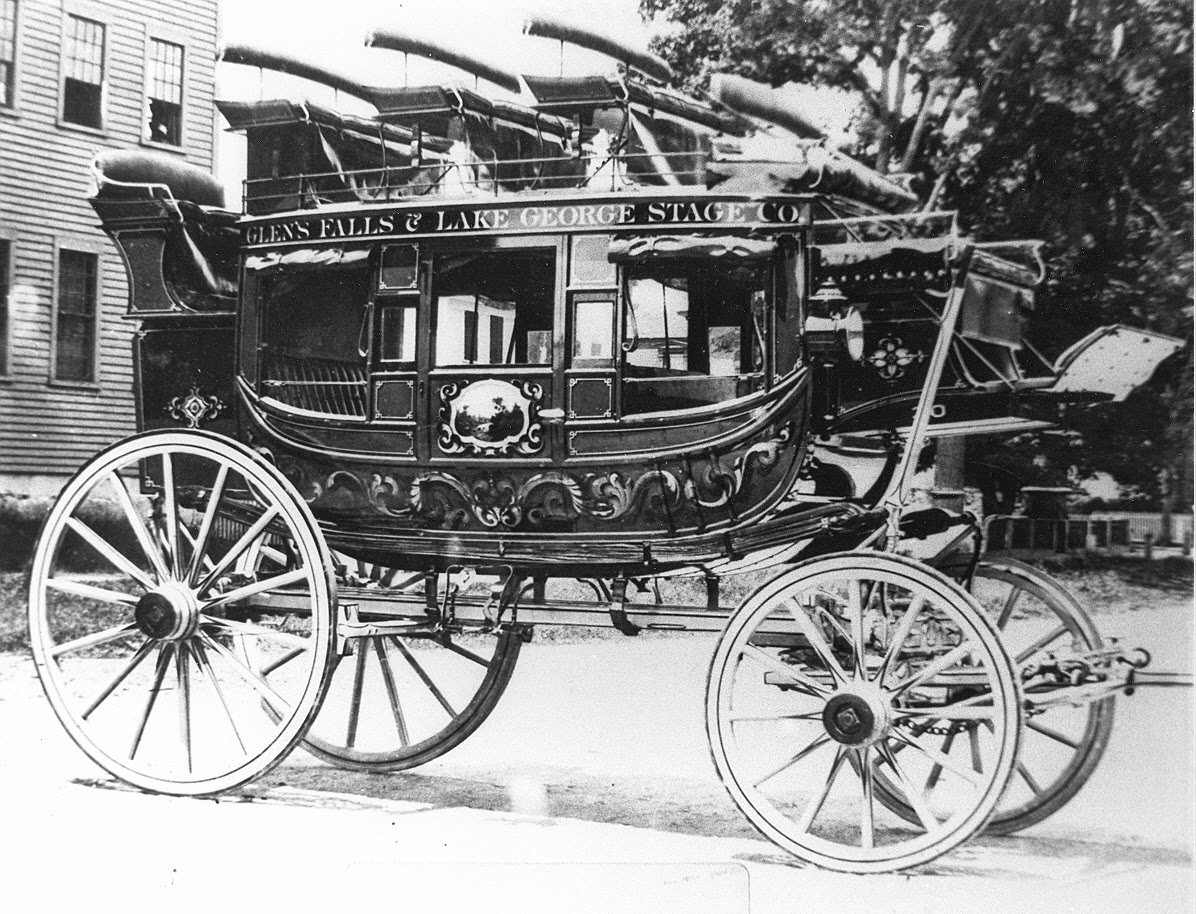

(A Concord Hotel Coach. Photo courtesy of http://199.253.17.48/Coachman.html)


Hansom Cab
  • Mainly used as a public vehicle, but had limited private use on occasion.
  • Most common in London. Gained acceptance in the U.S. in the late 19th Century, mainly in NYC.


Landau
  • Essentially a coach with a falling top.
  • Top is two separate pieces that lock together when up.

 (Photo courtesy of http://199.253.17.48/Coachman.html)

Opera Bus
  • Related to the Omnibus.
  • Public vehicle.
  • Sometimes called a Private Omnibus.
  • A short passenger compartment behind the elevated driver's seat with glass.
  • Seats run lengthwise facing one another, wagonette-style.
 (Photo courtesy of http://199.253.17.48/Coachman.html)

Victoria
  •  Mainly used as a park carriage.
  • Name was applied by the French in honor of Queen Victoria.
  • Panel-Boot Victorias have the driver's seat framed in the body. Sometimes called a Cabriolet.
  • Many Victorias have a child's seat that folds down from the rear of the panel-boot.
  • Methods of suspension vary.
  • Found with four elliptic springs, elliptic and platform springs, c-springs, or double suspension.
(An Eight-Spring Victoria.  Photo courtesy of http://199.253.17.48/Coachman.html)


Vis-à-Vis (also known as a Sociable)
  •  French for "face-to-face."
  • Name is derived from the passenger seating arrangement.
    • Originally built for two passengers, the body was later widened and some could carry six passengers.
    • Term was later used for passengers sitting facing one another.
(A Basket Body Vis-à-Vis. Photo courtesy of http://199.253.17.48/Coachman.html)

Yellowstone (or Sightseeing) Wagon
  • Passenger wagon on a thoroughbrace.
  • Used as an excursion or sightseeing wagon.
  • Built with an open body, three or four seats, and a canopy top.
  • Originated with Abbott-Downing Co. of Concord, NH.


Wanna give a guess at what kind of carriage ours is? Feel free! Comments are welcome below. Swing on by today to say hello and see this important piece of history.


Friday, January 9, 2015

20 Predicted Design Trends of 2015

According to HouseBeautiful,  the predicted color trends of 2015 are as follows...
  • 10 Color Trends
    • Greek Blues and Glossy Blues: Mediterranean dark Greek blues and deep rich blues with glossy finishes.
(Three Hands Blue Resin Wooden Table, Item # 99346, for sale at City Liquidators for $149.90)
    • 60s Shades: Shades from the 60s like oranges.
(Diamond Citadel Living Room Set in Camel for $1399 at City Liquidators)
    •  Sour Green Mixed with Blue.
(Uma Metal Blue Garden Bench for sale at City Liquidators for only $159.90)
(Uma Metal Green Table for sale at City Liquidators for only $69.99)
 
    • Pastel Palettes: the pastel palette of LA in the 80s-> the colors of orange and purple sunsets, green palm trees, aqua pools, and pink flamingos.
 (Uma Metal Bicycle Plant Stand, Item # 28946, for sale at City Liquidators for only $169)
    • Neutral Grays.
(Ashley Masterton Queen Bed, Item # B702-77-74, for sale at City Liquidators for only $399.90)
    • Renaissance-Inspired: the color or texture patterns of renaissance paintings like greens, plums, cerulean blues, beiges, and whites.
(Framed Print for sale at City Liquidators for $69.90)
    • Olive Greens.
 (Coaster Green Bench, Item # 500006, for sale at City Liquidators for $249.90)
    • Bold Color Mixing: ie-> pinks, purples, and vivid greens with aquas and turquoise.
 (Pink High Heel Shoe Chair in Pink Leopard, Item # U3208-09-32 Emerald, for sale at City Liquidators for only $179)
    • Warm Tones: rusts, olives, dusty mints, and eggplant colors.
(Uma Patterned Chest for $129.90)
    • Dynamic Pairings: ie-> blacks, grays, and whites with splashes of red and brown, blue and green, and/or citruses.

(Albert Einstein Framed Pop Art Print. Quote: "The most beautiful thing we can experience is the mysterious. It is the source of all true art and science." -Albert Einstein. For sale at City Liquidators for only $39.99)
As far as the house goes, the design trends predicted are as follows, according to Details.com
  • 10 Design Trends
    • Big, Comfy Sectionals.
 (Stanton Ace Chocolate Sectional, Series #186, for sale at City Liquidators as a set for $2199)
    •  Old Table, Mod Seats.
(Coaster Counter-Height Table, Item # 103718-T and -B, for sale at City Liquidators for only $799)
(Creative Images Oval Barstool in White, Item # S1125, for sale at City Liquidators for only $89.90)
    • Black Window Sashes.
      • This is when you paint your window panes black, like eyeliner around an eye. It gives the windows a bit of a pop.
( Photo courtesy of Houzz.com)
    • Vintage Tubs.
(Tubs for sale at City Liquidators in the $200 and under range)
    • Libraries as Decor.
 (Ashley Hamlyn Bookcase with Doors, Item # H527-18, for sale at City Liquidators for only $349.90)
    • Pale Driftwood Finishes.
 (Sauder Audio and Technology Pier in Dover Oak, August Hill Series, Item # 412321, for sale at City Liquidators for only $164.90)
    • Geometric Hexagons and Honeycomb Shapes.
 (Uma Wooden Wall Mirror, Item # 56087, for sale at City Liquidators for only $169)
    • Four-Poster Beds.
(Lifestyle Canopy Bed Frame, Set # 9241, for sale at City Liquidators for only $999)
    • Gridded Statement Light Fixtures.
      • We may not carry light fixtures, but we do carry some kick-butt lamps and lanterns! This gridded lantern below is a classic of ours and is selling for the great deal of $119.99!
 (Uma Wooden Lantern, Item # 50296, for sale at City Liquidators for only $119.99)
    • Vintage Brass. 
 (Vintage Brass Pots similar to the Image Above are for sale at City Liquidators for $11.90)
Not sure where to go for these things? Look no further than City Liquidators and we'll have you covered! Have a great one and we look forward to seeing you!

Wednesday, January 7, 2015

2 Books for Sale at City Liquidators: Stay Healthy This Year and Spoil Yourself at the Same Time

You like enjoying the finer things in life? So do we. For this year, we have 2 fantastic books for sale. The first one swears that you can still enjoy the finer things, like wine. What's the wonderful book that recommends this?

("The Bonus Years Diet: 7 Miracle Foods That Can Add Years to Your Life" by Ralph Felder, M.D., P.h.D., and Carol Colman, and Oscar H. Franco, M.D., P.h.D., Scientific Adviser. For sale for only $2.99!)

The following is a section from the read:
"Wine
Bonus Years RX: One 5-ounce glass of wine, preferably red
Bonus Years Benefit: Reduces the overall risk of cardiovascular disease by 32 percent
Note: Wine is the "broad spectrum" Bonus Years food-it offers a wide range of cardiovascular benefits.
  • Decreases LDL (bad cholesterol) and boosts HDL (good cholesterol)
  • Prevents the oxidation of LDL cholesterol, which injures the delicate lining of the blood vessels (the endothelium) and promotes the formation of artery-clogging plaque, and lowers blood pressure
  • Makes blood cells less sticky, which prevents dangerous blood clots" (Colman, pg. 26).

According to the second novel;

("The Body God Designed: How to Love the Body You've Got While You Get the Body You Want" by Gregory L. Jantz, PhD with Ann McMurray. For sale at City Liquidators for only $2.99!)

In this book, there's a section on "The Warm Embrace of Comfort Food" (Jantz, pg. 156). According to that section,   
"comfort food is physical, and it is emotional. It is snuggly, cuddly, feel-good food. The world can be harsh, stark, and edgy, so it's no surprise that you like your feel-good food... Even if you're increasing your fruits and vegetables each day, this type of food can be difficult to give up, because if you give it up, you think you're giving up comfort itself" (Jantz, 157).


Makes sense, right? Well there's no need to give up your comfort food, just replace it with something healthier, even if just slight.What is that something, you ask? Try wine. A glass of red wine a night has great health benefits, feels luxurious, and is great in a moderate amount. To go even further, pair it with something healthy. Something as simple as crackers, apples, and cheese or carrots and hummus is the perfect touch. Do this every day after work and you're golden. Doing this versus bread or bread and cheese with soda or cake after dinner is already pushing you towards your dieting goal of being healthier and happier.


Like this post? Want to check out these books further? Come and visit us at City Liquidators and pick up both books for 2 cents short of 5 dollars! Nowhere else will give you such a deal. Happy New Years and hope to see you all around!

Monday, January 5, 2015

Come Dissect with Us at City Liquidators (But Please Don't Dissect Us!)

In the land of the weird and wonderful (aka Portland), there exists a happy little (or big, REALLY big) haven that is City Liquidators. This magical place won a prestigious award in the long ago time of 2002 for "The Best Place to Indulge Your Medical Fetish" and has had quite a few enchanting and desired treasures hidden away that need new homes.

One of these enigmatic items is a vintage used and possibly haunted autopsy table for sale at the otherworldly price of $599.90 hailing from the distant kingdom of the Oregon Health and Science University.
Whether or not you are interested in this venerated piece of equipment, we have a special surprise for you. We have directions on how to do your very own autopsy (or just on how autopsies work, etc.).

*Disclaimer: Don't ACTUALLY try this, especially at home, and especially with real living or previously living or otherwise creatures and/or humans. If you do choose to try this, do it on a doll or unsuspecting stuffed animal. 

To make sure you're clear:
Safe (aka toy and not real-life autopsy)


NOT SAFE 
(aka too close to the murder of dead people for comfort, unless you're in a class, in which case, follow your professor's directions and not ours)


City Liquidators is in no way responsible for the stupidity and/or morbid explorations of crazy people, so please don't sue us. We should also add that this info is from medical references and we are in no way, shape, or form medical professionals. Thanks! Happy reading!*


But first, before we start anything, let's go over some general facts about autopsy.

The General Facts

"au.top.sy:
an examination of a body after death to determine the cause of death or the character and extent of changes produced by disease..." (Kotch).


 According to a powerpoint from Vanderbilt University Medical Center, an autopsy is also known as a necropsy, postmortem, or postmortem examination. Not only that, but autopsy means "to see for oneself" and has been used in professional practice since the 17th century, and in general much longer. The ancient Egyptians were actually the ones to start the nearest act to autopsy as they were among the first to "practice the removal and examination of the internal organs of humans in the religious practice of mummification" (Vanderbilt University Medical Center).


There are two types of autopsy out there; medical and forensic. "Medical autopsies are typically carried out by doctors while forensic autopsies are performed by pathologists/medical examiners" (Kotch). If you're wondering which of the two is usually the one that's in tv and movies, it's the latter, the kind usually used for police reports. This same source, having read a report by the American Society for Clinical Pathology, elaborates and discerns that the reason that autopsies are carried out is "to determine:
  • Quality assurance of medical diagnostics and service.
  • Public education.
  • The development of accurate mortality statistics.
  • The early identification of environmental, infectious, and occupational hazards to health.
  • Information documentation for future legal, financial, and medical evaluation.
  • Evaluation of new forms of therapy and new diagnostic modalities.
  • Continuing education of physicians" (Kotch).
Robert Valdes of howstuffworks.com elaborates on forensic autopsies by specifying who works on criminal death investigations, who are usually pathologists and forensic pathologists. According to him, a "pathologist studies the effects of diseases, medical treatments and injury on the human body..." while a "...forensic pathologist specializes in using these studies to establish a legal admissible manner of death in a court of law," (Valdes). Now as far as deaths go, he names the following:
  • Natural: if the autopsy shows the death was a result of a natural disease process (ie: leukemia, cancer, heart attack, blood clot, etc.).
  • Accident: when the answers to the reason for death aren't clear, but the evidence points to it happening accidentally (ie: falling, fire, car wreck, extreme heat or cold, etc.).
  • Homicide: murder.
  • Suicide: when the death is self-inflicted and intentional.
  • Undetermined: when the cause of death is a mystery. 
Now that we have the basic information, we can continue onto more of the particulars.

Medical Examiners and Coroners... What's the Difference?

  • Medical Examiner
    • Origin: France and Scotland; brought to the U.S. in the late 1800s.
    • Appointed local or state official; expected to be objective.
    • Term of office: serves continuously and is only removed with just cause.
    • Qualifications: Medical degree, complete with training and a certificate in forensic pathology.
    • Duties are to investigate the death of a person who died:
      • as a result of criminal violence, suicide, poisoning, accident, negligence, or disease constituting a public health threat.
      • unexpectedly, due to suspicious circumstances.
      • while they were in government custody, undergoing a medical procedure, or was unattended by a physician.
      • and is going to be cremated, dissected, or buried at sea.
  • Coroner
    • Origin: England, 12th Century; brought to North America in the 1600s.
    • In Britain, is either elected or appointed by the Crown, until 1888, when it was made appointive by the local council. In the U.S., is an elected local official; runs for office, often as a member of a political party.
    • Term of Office (in the U.S.): two to four years.
    • Qualifications: Citizenship, residence; no medical training required.
    • Duties are to convene an inquest or inquisition with a jury, to investigate the death of a person who died:
      • as a result of criminal violence, suicide, poisoning, accident, negligence, or disease constituting a public health threat.
      • unexpectedly, due to suspicious circumstances.
      • while they were in government custody, undergoing a medical procedure, or was unattended by a physician.
      • and is going to be cremated, dissected, or buried at sea.
(Information in this section referenced from Cases)


Still confused?


Well the difference is slight, but it's there. Dr. Kiesel, the Deputy Chief Medical Examiner of Fulton county explains it as follows;

"A medical examiner by definition is a physician... In most cases, they are trained to be forensic pathologists... and are appointed to their positions. To be a coroner, you just have to be able to be elected to the job. You've got places where the local feed store operator is a coroner. I've got a friend out in Washington State who's a farmer, who's the coroner of his county" (Valdes).

The reason for the coroner not needing many qualifications is due to resources in rural areas and the fact that all the coroner legally has to do is this:
  • Say if the person is dead or not.
  • Identify the body.
  • Notify the next of kin.
  • Collect and return any personal belongings on the body to the family of the deceased.
  • Sign the death certificate.
Got it? Ok. Let's continue.

Starting the Process

The body is taken to the morgue and is stored until examination time, which will be within 24 hours of death so the organs are still in one piece and embalming hasn't started yet. The body is stored in one of two cold chambers, according to the Vanderbilt University Medical Center:
  • Morgue + -> Positive Temperature (35.6/39.2°F)-> most usual for keeping bodies for a few days or weeks.
  • Morgue- -> Negative Temperature (5/-13°F)-> used for keeping bodies not identified yet. The body is completely frozen.
Information is then gathered about the deceased, including, but not limited to:
  • Medical records.
  • Doctor consultations.
  • Family member interviews.
  • Investigations of the area where the person died.
  • Studies on the circumstances surrounding the death.
  • Police consultations.
Then the following things occur:
  • Body is weighed, measured, and x-rayed.
  • Photos are taken of the body (front, back, and nude).
  • Fingerprints are taken (missing parts are noted, if any).
  • Area under the nails is scraped for evidence.
  • Clothes are examined.
  • Age, sex, and race are noted.
  • Eye color, scars, moles, tattoos, etc. are noted.
  • Eyes are examined (blood spots, etc.).
  • Body secretions and gun powder residue/bullet holes are noted.
  • Body fluids are drawn from the body for testing (blood, urine, spinal fluid, vitreous humour from the eye (eye goo), etc.).
  • Body is cleaned and prepared for the table.

(The above section's info is referenced from the Vanderbilt University Medical Center's site).

The Tools
  
  • Autopsy Wear:
    • Scrub Suits.
    • Gowns.
    • Gloves (two pair).
    • Shoe Covers.
    • Clear Plastic Face Shield.
  • Cadaver/Autopsy Table: is plumbed for running water and has several faucets for washing away blood from the procedure. The raised edges keep bodily fluids from running to the floor, and the table is about waist high.
  • Body Block: is a rubber or plastic "brick" that is placed under the back of the body, causing the arms and neck to fall back while pushing the chest upward to make it easier to slice open.
  • Bone Saw: used to cut through bone or skull.
  • Bread Knife: used to shave slices off of organs for examination.
  • Electric Saw: cuts the skull to expose the brain.
  • Enterotome: special scissors used to open the intestines.
  • Hagedorn Needle: a heavy needle used to sew up the body after examination.

  • Hammer with Hook: used to pull the skull cap off of the skull.
  • Handheld Voice Recorder: to take verbal notes before, throughout, and after the procedure. 
  • Rib Cutter: special sheers used to cut through the ribs.
  • Scalpel: like a surgeon's scalpel, but with a much larger blade (the largest possible) for making long deep cuts or scraping away tissue.
  • Scissors: used for opening hollow organs and cutting vessels.
  • Skull Chisel: used for carefully prying the skull cap off.
  • Stryker Saw: the electric saw used to cut through the skull to remove the brain. 
  • Toothed Forceps: used to pick up heavy organs.
(Info courtesy of Valdes).

The Process

Once the body is externally examined and dressed down, the internal autopsy process starts. The whole process is pretty gruesome, so here are the paraphrased facts. If you want to read more in-detail, click here.
  • A Y-incision is made on the torso, which goes from from shoulder to shoulder and meets at the breast bone (but curves with a woman below the breasts) before descending in a line down to the pubic bone.
  • Skin, muscle, and soft tissue are peeled back. The skull is opened and the brain is looked at. Organs are removed, dissected, and looked at, as well as various blood vessels and bones. More cuts are made. The whole body is essentially pulled apart, while the person(s) conducting the investigation look(s) for:
    • organ weight.
    • tissue samples to take.
    • evidence of trauma or other indications of the cause of death.
(Info courtesy of Valdes).

Preparing the Body for the Funeral Home


To give you an idea of just how gruesome this whole process is, by the end of it, "the body has an open and empty chest cavity with butterflied chest flaps, the top of the skull is missing, and the skull flaps are pulled over the face and neck" (Valdes). This is the reason we decided to skip the gory details. Now from here, the examiner has to prepare the body for the funeral home. In order to do so, they: 

  • either put the organs back in the body or have them incinerated.
  • close the chest flaps and sew them together.
  • put the skull cap back into place and sew it down.
They then contact the funeral home to pick up the body.
(Info courtesy of Valdes).

The Autopsy Table

Enjoy this blog post? Want to include something magnificently creepy and/or eclectic in your home? Well come on by City Liquidators and pick up your very own autopsy table (a picture of ours is below) for only $599!


Have a great day!

 
References


Friday, January 2, 2015

2014 Interior Design: A Year in Review

Happy New Year everybody! As another year comes and goes, we'd like to take the time to reflect on the design trends of the home from 2014. Enjoy!


1) Vintage Accents.
Vintage accents have always been a timeless classic to any room, and the trend has lived on through 2014. One of our favorite picks from our store is this classic victorian-style bistro set for only $119.99


2) Honey-Tone Woods.
Honey and lighter-colored woods came back to roost this past year, bringing warmth and feelings of home to any room they occupied. One example that we carry is transitional 60" bookcases in warm oak for only $199.90.
3) Turquoise and Shades of Gray.
These colors were big in this past year. The lighter shades of gray substituted for neutrals with bursts of turquoise for color and contrast. These weren't always used together, but these were some of the main colors of the past year. Want to bring some of these into your home? Try picking up one of our many beautiful rugs like the one below in any size and color of your choice.


4) Texture as Priority-> Hair on Hide, Fuzzy Rugs, and Plush Throws.
It's as easy as placing a few textured candle holders (candles included) out on the table for as little as $1.99 each.

5) Outdoor and Indoor Furniture Becoming Interchangeable.
There are no rules when it comes to decorating your home and the people of 2014 have taken that opportunity to mix and match what goes inside and out. Don't let labels restrain you, that is so two years ago. Want to put an armoire outside for your gardening supplies or outdoor dining needs? Buy this one by Aspen from us for only $999 and make all your dreams come true!

Curious about the 2015 trends? Stay tuned for next Friday's post and find out. Happy decorating!


References